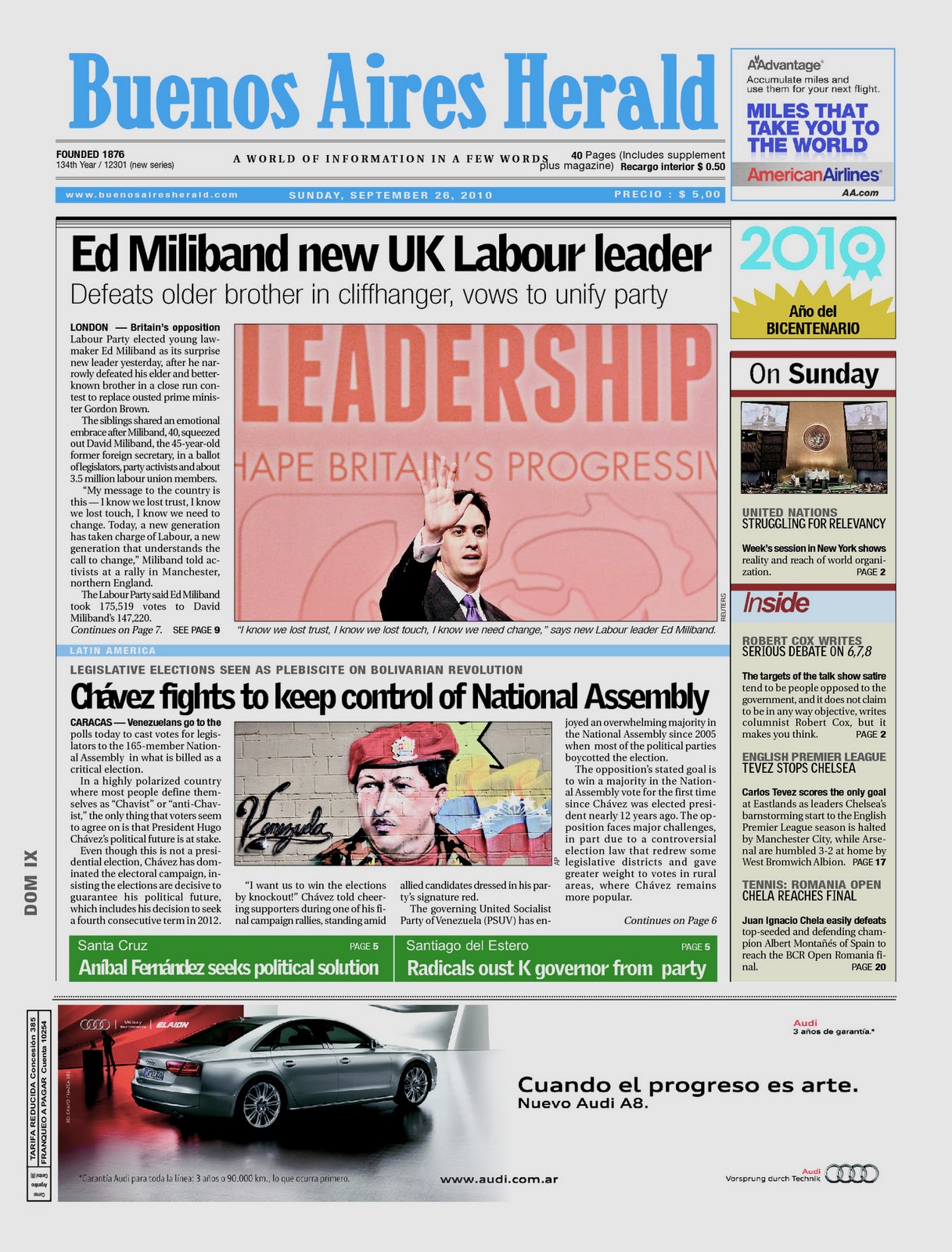
domingo, 26 de septiembre de 2010

Santa Cruz: gov’t seeks ‘political solution’

Cabinet Chief Aníbal Fernández claims ‘there is no other way out’
Cabinet Chief Aníbal Fernández called yesterday for “a political solution” to the conflict in Santa Cruz province over the Supreme Court ruling demanding the restitution of prosecutor Eduardo Sosa, fired by former president Néstor Kirchner in 1995 during his stint as governor. Meanwhile, Radical Deputy Ricardo Gil Lavedra condemned the graffiti sprayed by pro-government activists in the province against the Radical Party leaders last week, which he considered as “an overreaction of the ruling party leadership.”
Aníbal Fernández said Supreme Court Judge Eugenio Zaffaroni had stated in an interview earlier last week that “the only solution (to the conflict) is political” and agreed with the Court official
“If a Justice of the (Supreme) Court, who is part of the issue, says that, it is because the situation is complex,” said Fernández during a radio interview yesterday. “The only way out is political, there is no other solution,” added the Cabinet Chief, who backed Governor Daniel Peralta.
“A political way out is what the Governor suggested to the legislature,” said Fernández. “The prosecutor post is split in two, so the one that is currently on the post doesn’t have to leave and the new post created will solve the problem of Sosa, who had complained about his sidelining,” he added.

Fernández insisted “that is what Peralta suggested and the legislature will have to make a decision.”
“This situation of public provincial right never reaches the Court,” said Fernández. “It reached the old Court with automatic majority because the goal was to pressure the provincial government for other reasons,” added the Cabinet Chief in reference to the complaint filed by Sosa after being sacked in 1995.
Fernández claimed the issue reached the Supreme Court back then due to the fact that Kirchner’s administration, which ruled the sidelining of Sosa, “did not obey the orders of the national government” of former president Carlos Saúl Menem.
The Supreme Court has ordered the reinstatement of Sosa in his post, but the provincial administration has refused to obey the ruling claiming they cannot sack the current prosecutor — a position that has been publicly supported by the national government.
The Radical Party presented a bill requesting the federal intervention of Santa Cruz to restore Sosa in his post, and were accused by pro-government activists of being “coup mongers.”
Gil Lavedra said “an absolute tall story has been set up” in the province “saying we are trying to sack local authorities,” and insisted the Radical bill does not contemplate the replacement of the province Governor or Lieutenant Governor.
The Radical Deputy said the bill contemplates “an intervention with no sidelining” and aims to obey the Supreme Court ruling: “Remove the current prosecutor (Claudio Espinosa) and restore Sosa.”
“Under no circumstance the other branches of power in the province will suffer any interference in their functions,” said Gil Lavedra.

lunes, 13 de septiembre de 2010

Kirchner discharged from hospital

 After undergoing surgery late Saturday night
By Pablo Krause
Herald staff

Former president Néstor Kirchner was discharged from hospital yesterday after recovering from an angioplasty on a coronary artery performed on him after being hospitalized late on Saturday at a private clinic in the Buenos Aires city neighbourhood of Palermo.
Kirchner, 60, left the Sanatorio de los Arcos clinic at 8.20pm yesterday in company of his wife, President Cristina Fernández de Kirchner, in an automobile that took him to the presidential residence of Olivos, in Greater Buenos Aires.
A stent was placed in an obstructed coronary artery during the operation, which was done with local anesthesia, Presidential Secretary Oscar Parrilli said.

In brief statements to the press standing outside the clinic, Kirchner said he felt “perfect” and thanked government officials, political leaders and party activists for their support.
The President’s husband was admitted to the Palermo clinic, where he arrived from the Clínica Olivos, a private clinic nearby the presidential residence which he allegedly attended on Saturday afternoon for a “routine checkup,” according to his spokesmen.

The current Deputy and head of the UNASUR Union of South American Nations has a history of heart disease and felt numbness in his legs during an alleged routine checkup, which led to doctors advising an immediate angioplasty, for which he was transferred to the Palermo clinic.
Kirchner went to the same clinic for emergency surgery last February to remove a plaque from his right carotid artery after having trouble moving his arm.
According to press reports quoting sources close to the former president, Kirchner was taken to the Olivos clinic after feeling “a pain on his chest” during the afternoon.
Carotid artery disease involves the narrowing of the main arteries that carry blood from the heart to the brain. These arteries can thicken with fatty substances and deposits of cholesterol known as plaque, slowing the flow of oxygenated blood to the brain and increasing the risk of a stroke.
In a joint statement released yesterday afternoon, presidential Doctor Luis Buonomo and physician Marcelo Ballesteros of the Los Arcos clinic said Kirchner was having a “favourable recovery” after the angioplasty and added “evaluation studies were carried out and results were in the range of normal values.”
Around 8pm yesterday, Media Under-Secretary Alfredo Scocchimarro confirmed the “institutional discharge” of the former president, who left the clinic minutes afterwards.
President Cristina Fernández de Kirchner spent the night at the clinic by the side of her husband and only left the institution for a few hours yesterday at noon.
Kirchner was visited by Parrilli, Cabinet Chief Aníbal Fernández, Planning Minister Julio De Vido, Economy Minister Amado Boudou, former Senator José Antonio Romero Feris and boxer Jorge “Roña” Castro.
After spending more than an hour at the clinic, the Cabinet Chief said he found Kirchner “in a good mood and looking all right.”
Meanwhile, pro-government activists from La Cámpora, Martín Fierro and Juventud Peronista organizations stood outside the clinic for several hours to express their support to the former president.
 

domingo, 12 de septiembre de 2010

Cobos-Alfonsín: Party unity first

Radical presidential frontrunners agree non-aggression pact
By Pablo Krause
Herald staff

Vice-President Julio Cobos and Radical Deputy Ricardo Alfonsín — the two top contenders in the Radical Party for the presidential nomination next year — met in Tucumán province yesterday and agreed to stay united through the campaign, in a tacit non-aggression pact between the two.
“Nothing should jeopardize the unity of the party or the (electoral) front,” said Alfonsín after the meeting staged at the house of Radical Senator José Cano in San Miguel de Tucumán.
The two Radical leaders agreed on “sending out signals of unity” and pledged to support the candidates for mayor or governor of either faction who perform best in polls.
Cano — who aims to run for Tucumán governor and hosted yesterday’s talks — became the first candidate to have the support of both Alfonsín and Cobos for his candidacy.

In a press conference held after the meeting with Cano, both Alfonsín and Cobos said they had not discussed the issue of presidential candidacies. “The next step now is to construct a government programme to present to society,” said Alfonsín.
 

Cobos also said technical advisers of both candidates will meet with the National Committee and  Radical Convention authorities on September 20 and 24 to start working on developing the party’s government platform for the 2011 elections.
According to press reports, the meeting with the National Committee was scheduled by Radical Party chairman Ernesto Sanz and would also include the head of the Radical caucuses in the Lower House and the Senate, Deputy Oscar Aguad and former party chairman Senator Gerardo Morales.
Both leaders agreed the electoral platform should be defined before the end of the year.

Alfonsín insisted the presidential candidacies “could be decided by consensus,” while Cobos said “the citizens will express themselves in the primaries of August (2011).”
Although the Vice-President insisted the current electoral law establishes “a process of open primaries,” he admitted “that does not rule out the possibility of reaching an agreement” on the candidacies, which has been demanded by other sectors in order to avoid confrontation between the two.
In that sense, Deputy Margarita Stolbizer — head of the GEN Party — said yesterday: “I think it’s excellent that Cobos and Alfonsín meet here in Tucumán, because is something that we have been requesting.”
“Without meddling in the Radical primaries, we think it is very positive for them to meet as a sign of unity,” said Stolbizer.

Meanwhile, both contenders praised “the current favourable international conditions for the country” and agreed on “the need to grant a frame of predictability for international investments.”
Cobos also said that after the meeting, “the stage of reaching agreements with our GEN and the Socialist Party allies to move forward on the construction of a progressive front will come.”
In that sense, Alfonsín urged Civic Coalition leader Elisa Carrió to “reconsider her decision” of breaking ties with the Social and Civic Accord as “nothing has happened to justify that decision.”
The son of late former president Rául Alfonsín also downplayed the rumours of a rally to launch his presidential candidacy at the indoor Luna Park stadium on October 30.
“That’s just a proposal which was made by some friends, which we are currently evaluating, but the important thing is to make progress on the (government) programme,” said Alfonsín.
Cobos and Alfonsín were invited to Tucumán by the Moisés Lebensohn Institute — a Radical branch close to the Vice-President — to participate in a conference at the National University of Tucumán and there was wide speculation about a meeting between the two.
According to press reports, the talks were not confirmed until Cobos called Alfonsín from Catamarca province on Friday, asking him to meet.

sábado, 11 de septiembre de 2010

Nightclub VIP lounge collapses

Two young women killed, city officials say building permits in order
By Pablo Krause
Herald staff

The mezzanine of a night club in the Buenos Aires city neighbourhood of Palermo collapsed yesterday killing two women and injuring 24 people, who were reportedly out of danger.
The accident occurred minutes before 4am yesterday at the VIP room of the Beara nightclub, on Scalabrini Ortiz avenue.
The two women killed were identified as Adriana Lizarraga, 20, and Leticia Provedo, 21, Fernández Hospital sources said.
Sergio Aranda, one of the members of tropical group Ráfaga which had just finished their gig at the night club, said: “We heard an awful noise and the ordeal began. There were people crying everywhere,” said Aranda, who added a private party was being held for around 300 people.
At least 20 people — all of them between 18 and 29 years of age — were transferred to different city hospitals while another five youngsters went to private clinics, according to SAME Emergency Service head Alberto Crescenti.


 The nightclub had permits and the number of people inside the club did not exceed the amount of people allowed by the law, the city government said.
City Cabinet Chief Horacio Rodríguez Larreta said several inspections were conducted during the last year without registering any irregularities.
“An in-depth investigation will have to be carried out to establish what went wrong,” Rodríguez Larreta said.
The accident happened only a month after the collapse of a gym in the neighbourhood of Villa Urquiza which killed three people and injured 11 on August 9.
Relatives and friends of the victims of the gym cave-in demonstrated on Thursday to mark the first month since the accident and demand justice.
Buenos Aires City Mayor Mauricio Macri, who is currently in Rome, expressed his “condolences to the families of the victims” via Twitter and praised the work of the emergency services during the accident.
“I want to express my condolences to the families of the two girls killed today in the collapse,” Macri posted on his Twitter account.
“Also I would like to thank the doctors, firefighters and policemen who did a great job during the emergency,” the centre-right mayor wrote.
In an official statement released yesterday, the city government said Macri “brought forward his return to Buenos Aires ahead of the tragedy that occurred at the Beara club and ended his tour through Spain, France and Italy after the meeting he shared with Rome Mayor Gianni Alemanno.”
Although Macri had no activities scheduled after the meeting with Alemanno, government sources explained “his return was scheduled for Monday but was brought forward for Sunday.”
Several opposition figures criticized the city government and Macri after the collapse.
Cabinet Chief Aníbal Fernández said Macri’s administration “will have to give explanations” about the inspections carried out at the nightclub, while Foreign Minister Héctor Timerman posted several messages on his Twitter account directed to the city Mayor.
“Macri is taking a walk in Paris speaks about solving ‘the isolation of the country,’ he’d better  prevent the city from collapsing or the schools from falling down,” Timerman posted via Twitter.
Judge Alicia Iermini asked the city government to report on the inspections carried out at Beara, as well as the official plans and other documentation.
The judge also questioned the employees who were present at the time of the collapse and was waiting for survivors to be discharged from the hospital to summon them.
Rodríguez Larreta attributed the tragedy to the “misuse of the mezzanine” at the nightclub as he claimed “the authorization was granted correctly and several controls were carried out” and “no irregularities were found.”
In a press conference staged yesterday, the head of the Government Control Agency Javier Ibáñez said “several people moved to the mezzanine and started jumping,” while Macri’s Chief-of-staff Marcos Peña claimed “what happened was clearly a misuse” of the facilities.
An official statement said the nightclub had been controlled nine times this year, the last inspection was carried out on September 5.
The manager and one of the owners of the nightclub were in custody yesterday, while the owner’s lawyer linked the tragedy to “a failure in the construction materials.” Beara was authorized since August 29, 2009, as restaurant, coffee-bar and house for private parties and had a maximum capacity of 491 people, government sources said.
 

sábado, 4 de septiembre de 2010

Erdogan cancellation sparks controversy

No one takes blame

By Pablo Krause

Herald Staff


The cancellation of the visit by Turkish Prime Minister Recep Tayyip Erdogan, who was scheduled to arrive in Buenos Aires yesterday but suspended his trip late on Saturday, led to the governments of President Cristina Fernández de Kirchner and Buenos Aires City Mayor Mauricio Macri swapping the blame.
The CFK administration released a statement late on Saturday citing the cancellation of a ceremony scheduled for this morning to place a bust in honour of Mustafa Kemal Atatürk (the founder of the modern Turkish Republic) as the reason for Erdogan’s decision and blaming the Macri administration for the incident. However, City Hall rejected the accusations and claimed that no such ceremony was scheduled.
Yesterday, the city Foreign Affairs Department released an official statement expressing its regret over the suspension of Erdogan’s visit but insisting that the alleged ceremony was never on City Hall’s schedule.
“In reference to the statements of the Foreign Ministry, we insist the alleged ceremony as well as the placing of a bust of former Premier Atatürk was never authorized or communicated to that Ministry or the Turkish Embassy and it would have required a law approved by the local legislature in order to carry it out,” read the statement.
Asked by the Herald about the incident, PRO Foreign Affairs Secretary Diego Guelar said: “The Turkish Embassy requested permission from the Public Space Ministry to erect a monument to Atatürk about six months ago, allegedly in replacement of an existing bust, but the ministry confirmed there was no previous bust so the request did not progress.”
Guelar claimed: “There was never any ceremony scheduled neither was there an existing Atatürk bust to replace” and insisted such a bill would have needed the approval of the Mayor and the city legislature.
“There was no such ceremony on the schedule of Mauricio (Macri) for Monday,” Guelar told the Herald.
“We don’t know why the tribute was in the Ambassador’s agenda because it would have required a resolution signed by Macri, which he didn’t,” added the Foreign Affairs Secretary of PRO.
Guelar claimed City Hall became aware of the ceremony on Friday when the Armenian community requested an interview with Environment and Public Space Minister Diego Santilli to protest against the display of the Turkish founder’s bust, which was due to be unveiled in a park at the intersection of Figueroa Alcorta and Sarmiento avenues.
The Armenian community published a paid ad in a local newspaper on Saturday, repudiating Erdogan’s visit and making reference to the inauguration of Atatürk’s statue. Later on Saturday, the Foreign Ministry confirmed the Turkish Prime Minister had cancelled his visit and said Erdogan took offence at “a decision by Buenos Aires Mayor Mauricio Macri to cancel a scheduled tribute in which he was to take part.”
Foreign Ministry sources consulted by the Herald yesterday denied the City Hall statements and insisted the ceremony was part of Erdogan’s agenda for his visit.
Sources claimed Erdogan himself told Taiana in Brazil the suspension of the ceremony was the reason of his cancellation.
In statements to local media, Turkish Ambassador to Buenos Aires Hayri Hayret Yalav said the procedures for the monument “started in November, 2009 and there was no problem until yesterday (for Saturday) when Santilli informed me in a letter that the monument would not be placed.”
News agency Reuters reported Turkey’s Foreign Ministry confirmed in a statement the two-day visit scheduled had been cancelled and blamed the move on Armenian lobbyists.
“The trip was cancelled because written permission for the monument given to Turkey beforehand by the Buenos Aires district was reversed as a result of initiatives by the Armenian lobby, which is opposed to Turkey,” said the statement, adding Turkey hoped Argentina would take steps to remove the shadow cast on Turco-Argentine relations.
According to Reuters, President Fernández de Kirchner spoke with Erdogan to explain she could not overrule the decision, yet he found this unacceptable and decided not to go, the statement added.
The Herald was unable to reach Turkish Embassy sources yesterday but a brief statement was released informing the cancellation of a forum at a downtown hotel where Erdogan was scheduled to participate, quoting “last-minute changes in the Prime Minister’s agenda.”
Despite the official explanations and the exchange of accusations between the city and national governments, several rumours spread about the reasons behind Erdogan’s cancellation.
City Hall sources which requested not to be named said the incident “could have been a misunderstanding on the part of the Turkish Embassy, which might have assumed the ceremony was already scheduled, despite having received no confirmation from the city government.”
On the other hand, a source from the Foreign Ministry consulted by the Herald, who also requested that their name not be published, said there was “a verbal agreement” between Macri and the Turkish Embassy for the ceremony but the city administration decided to cancel it following the protests of the Armenian community.
Mustafa Kemal Atatürk, the first Turkish President and founder of the Republic of Turkey, is highly revered by Turks, but Armenians cite him as one of the main culprits for the mass killing of Armenians in 1915, known as “the Armenian Genocide.”
All officials consulted agreed the cancellation was a serious incident and an offence to the Turkish Prime Minister, comparing the situation to a last-minute suspension of a monument to national independence hero José de San Martín or a memorial of the Malvinas War during the visit of an Argentine president to a foreign country.
Some observers had even cited a possible link between the cancellation of Erdogan’s visit and the nuclear fuel agreement signed by Iran — which Brazil and Turkey have supported despite the protests from the United States and on which Argentina has not yet taken a position. However, all sources consulted by the Herald denied such possibility both on and off the record.

Link: http://www.buenosairesherald.com/BreakingNews/View/35044