Mostrando entradas con la etiqueta Entertainment. Mostrar todas las entradas

sábado, 4 de septiembre de 2010

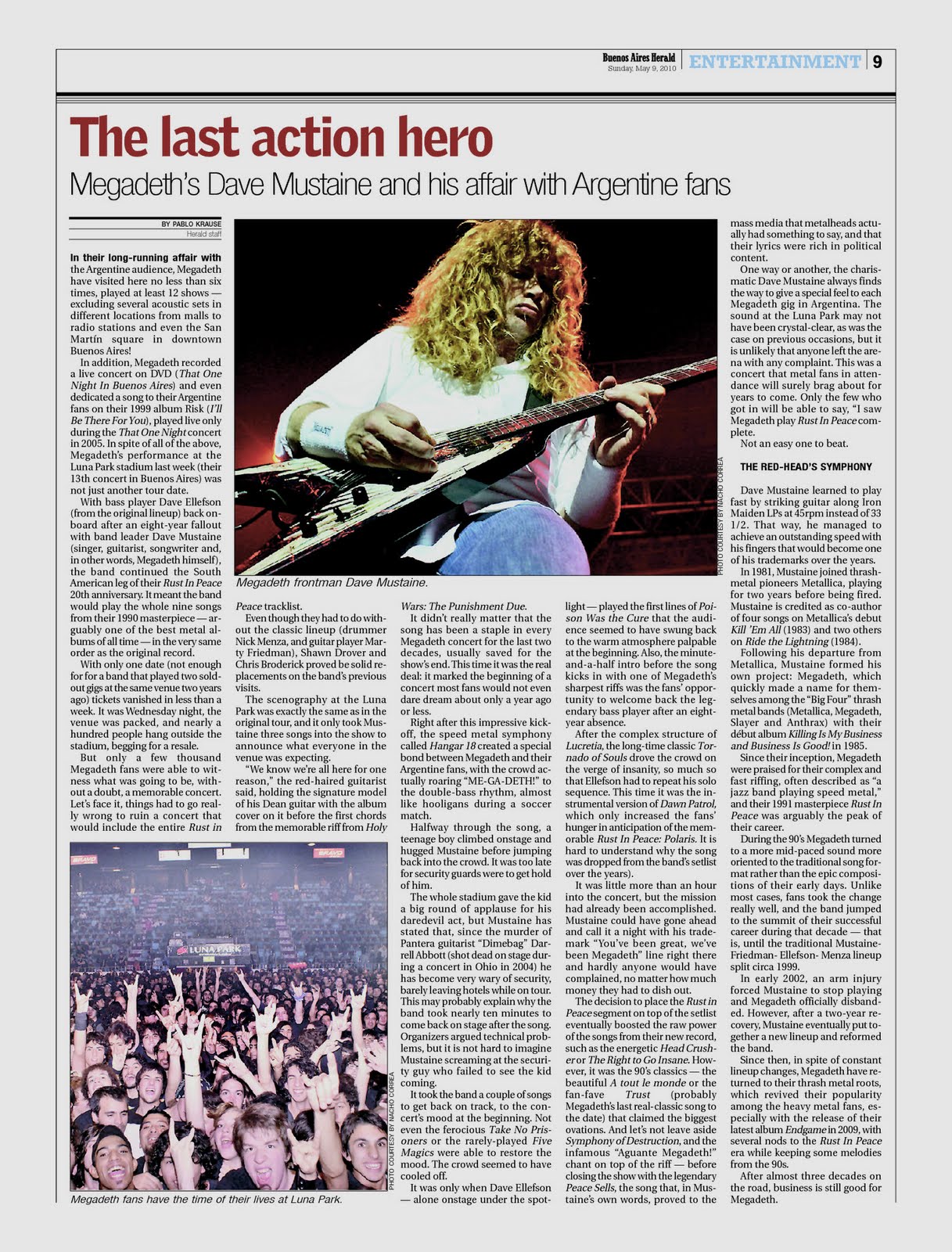
The last action hero


Megadeth’s Dave Mustaine and his affair with Argentine fans
By Pablo Krause
Herald staff

In their long-running affair with the Argentine audience, Megadeth have visited here no less than six times, played at least 12 shows — excluding several acoustic sets in different locations from malls to radio stations and even the San Martín square in downtown Buenos Aires!
In addition, Megadeth recorded a live concert on DVD (That One Night In Buenos Aires) and even dedicated a song to their Argentine fans on their 1999 album Risk (I’ll Be There For You), played live only during the That One Night concert in 2005. In spite of all of the above, Megadeth’s performance at the Luna Park stadium last week (their 13th concert in Buenos Aires) was not just another tour date.
With bass player Dave Ellefson (from the original lineup) back onboard after an eight-year fallout with band leader Dave Mustaine (singer, guitarist, songwriter and, in other words, Megadeth himself), the band continued the South American leg of their Rust In Peace 20th anniversary. It meant the band would play the whole nine songs from their 1990 masterpiece — arguably one of the best metal albums of all time — in the very same order as the original record.
With only one date (not enough for for a band that played two soldout gigs at the same venue two years ago) tickets vanished in less than a week. It was Wednesday night, the venue was packed, and nearly a hundred people hang outside the stadium, begging for a resale.
But only a few thousand Megadeth fans were able to witness what was going to be, without a doubt, a memorable concert. Let’s face it, things had to go really wrong to ruin a concert that would include the entire Rust in Peace tracklist.
Even though they had to do without the classic lineup (drummer Nick Menza, and guitar player Marty Friedman), Shawn Drover and Chris Broderick proved be solid replacements on the band’s previous visits.
The scenography at the Luna Park was exactly the same as in the original tour, and it only took Mustaine three songs into the show to announce what everyone in the venue was expecting.
“We know we’re all here for one reason,” the red-haired guitarist said, holding the signature model of his Dean guitar with the album cover on it before the first chords from the memorable riff from Holy Wars: The Punishment Due.
It didn’t really matter that the song has been a staple in every Megadeth concert for the last two decades, usually saved for the show’s end. This time it was the real deal: it marked the beginning of a concert most fans would not even dare dream about only a year ago or less.
Right after this impressive kickoff, the speed metal symphony called Hangar 18 created a special bond between Megadeth and their Argentine fans, with the crowd actually roaring “ME-GA-DETH!” to the double-bass rhythm, almost like hooligans during a soccer match.
Halfway through the song, a teenage boy climbed onstage and hugged Mustaine before jumping back into the crowd. It was too late for security guards were to get hold of him.
The whole stadium gave the kid a big round of applause for his daredevil act, but Mustaine has stated that, since the murder of Pantera guitarist “Dimebag” Darrell Abbott (shot dead on stage during a concert in Ohio in 2004) he has become very wary of security, barely leaving hotels while on tour. This may probably explain why the band took nearly ten minutes to come back on stage after the song. Organizers argued technical problems, but it is not hard to imagine Mustaine screaming at the security guy who failed to see the kid coming.
It took the band a couple of songs to get back on track, to the concert’s mood at the beginning. Not even the ferocious Take No Prisoners or the rarely-played Five Magics were able to restore the mood. The crowd seemed to have cooled off.
It was only when Dave Ellefson — alone onstage under the spotlight — played the first lines of Poison Was the Cure that the audience seemed to have swung back to the warm atmosphere palpable at the beginning. Also, the minute-and-a-half intro before the song kicks in with one of Megadeth’s sharpest riffs was the fans’ opportunity to welcome back the legendary bass player after an eight-year absence.
After the complex structure of Lucretia, the long-time classic Tornado of Souls drove the crowd on the verge of insanity, so much so that Ellefson had to repeat his solo sequence. This time it was the instrumental version of Dawn Patrol, which only increased the fans’ hunger in anticipation of the memorable Rust In Peace: Polaris. It is hard to understand why the song was dropped from the band’s setlist over the years).
It was little more than an hour into the concert, but the mission had already been accomplished. Mustaine could have gone ahead and call it a night with his trademark “You’ve been great, we’ve been Megadeth” line right there and hardly anyone would have complained, no matter how much money they had to dish out.
The decision to place the Rust in Peace segment on top of the setlist eventually boosted the raw power of the songs from their new record, such as the energetic Head Crusher or The Right to Go Insane. However, it was the 90’s classics — the beautiful A tout le monde or the fan-fave Trust (probably Megadeth’s last real-classic song to the date) that claimed the biggest ovations. And let’s not leave aside Symphony of Destruction, and the infamous “Aguante Megadeth!” chant on top of the riff — before closing the show with the legendary Peace Sells, the song that, in Mustaine’s own words, proved to the mass media that metalheads actually had something to say, and that their lyrics were rich in political content.
One way or another, the charismatic Dave Mustaine always finds the way to give a special feel to each Megadeth gig in Argentina. The sound at the Luna Park may not have been crystal-clear, as was the case on previous occasions, but it is unlikely that anyone left the arena with any complaint. This was a concert that metal fans in attendance will surely brag about for years to come. Only the few who got in will be able to say, “I saw Megadeth play Rust In Peace complete.
“ Not an easy one to beat.

THE RED-HEAD’S SYMPHONY
Dave Mustaine learned to play fast by striking guitar along Iron Maiden LPs at 45rpm instead of 33 1/2. That way, he managed to achieve an outstanding speed with his fingers that would become one of his trademarks over the years.
In 1981, Mustaine joined thrash-metal pioneers Metallica, playing for two years before being fired. Mustaine is credited as co-author of four songs on Metallica’s debut Kill ’Em All (1983) and two others on Ride the Lightning (1984).
Following his departure from Metallica, Mustaine formed his own project: Megadeth, which quickly made a name for themselves among the “Big Four” thrash metal bands (Metallica, Megadeth, Slayer and Anthrax) with their début album Killing Is My Business and Business Is Good! in 1985.
Since their inception, Megadeth were praised for their complex and fast riffing, often described as “a jazz band playing speed metal,” and their 1991 masterpiece Rust In Peace was arguably the peak of their career.
During the 90’s Megadeth turned to a more mid-paced sound more oriented to the traditional song format rather than the epic compositions of their early days. Unlike most cases, fans took the change really well, and the band jumped to the summit of their successful career during that decade — that is, until the traditional Mustaine-Friedman- Ellefson- Menza lineup split circa 1999.
In early 2002, an arm injury forced Mustaine to stop playing and Megadeth officially disbanded. However, after a two-year recovery, Mustaine eventually put together a new lineup and reformed the band.
Since then, in spite of constant lineup changes, Megadeth have returned to their thrash metal roots, which revived their popularity among the heavy metal fans, especially with the release of their latest album Endgame in 2009, with several nods to the Rust In Peace era while keeping some melodies from the 90s.
After almost three decades on the road, business is still good for Megadeth.

Link: http://www.buenosairesherald.com/PrintedEdition/View/32892

The day that finally came

After their 2003 show cancellation, Metallica make it up to fans with two memorable shows

By Pablo Krause
Herald staff

Ten years have passed since the last time Metallica had last set foot on Argentine soil. Ten long years where, in between, thousands of fans had the bitter disappointment of the last-minute cancellation of their South American tour in 2003. However, Metallica aimed to make it up to their fans with two shows at River Plate stadium on last Thursday and Friday — the first of which sold out.
And what a comeback it was. With the band's latest record Death Magnetic taking the group back to their thrash metal roots — something long-awaited, if not demanded by their fans — the World Magnetic tour had focused in their old-school classics, playing little or nothing from their most questioned albums of the 1990s. In other words, anything a Metallica fan would have wanted.
Therefore, the blood of almost 60,000 people seemed to boil as the lights went down in River and The Ecstasy of Gold — the instrumental piece of The Good, The Bad and The Ugly soundtrack by Ennio Morricone which Metallica currently uses as their opener — started to sound on the speakers of the Monumental, only to be abruptly interrupted by the crunching riff of Creeping Death, one of Metallica's biggest classic from their 1984 album Ride The Lightning.
It was the moment thousands of fans had been waiting for over a decade. A massive release of anxiety, frustration and joy translated into hundreds of head-banging heads, thousands of fists in the air and throats that seemed to scream their lungs out.
It seems hard to believe that the four musicians on stage — singer and guitarist James Hetfield, Danish drummer Lars Ulrich, guitarist Kirk Hammet and bass player Robert Trujillo — will be pushing 50 in a few years (all of them were born between 1962 and 1964). All four continue to deliver an energetic performance and the band proves to be one of the tightest and most powerful acts in the business.
It is true that Hetfield's vocals have became cleaner over the years in comparison to that furious 20-year-old that recorded Kill 'Em All in 1983 almost tearing off his vocal chords, but his singing continues to make blood run cold as he intonates long running classics such as For Whom The Bell Tolls or Ride The Lightning with a deeper and more obscure approach.
Besides, Hetfield is probably one of the most hypnotising frontmen, his sole presence makes it almost impossible to take the eyes off him as he stands in front of the microphone opening his legs and bending his knees in which has already became his trademark pose.
Still, he is not the only one. Ulrich isn’t a static drummer and he is permanently jumping off his drum kit, standing up and screaming at the audience as he plays, acting as the perfect counterweight for Hetfield's hypnotising presence along with Trujillo's constant monkey-moves as he moves through the stage.
Despite the almost 30 years that had passed since its foundation, Metallica probes they still have a lot to offer. Both of the shows at River Plate were equally memorable, as the band modifies its setlist every night, making each show different from one another.
Of course, “mandatory songs” were part of both concerts. Fire and explosions gave way to the epic war story in One while the whole stadium punched their fist in the air to scream “Master! Master!” on Master of Puppets and fireworks lit up the stadium as the whole crowd sang the chorus of Enter Sandman, probably the band’s most well-known song ever.
However, several songs gave each concert its own identity. On Thursday, where the setlist cleared concentrated on the band's biggest hits, Wherever I May Roam and Harvester of Sorrow were part of the unexpected classics while the furious Blackened seemed to be a nod to the die-hard fans.
On the other hand, Friday's show featured some of the old-school fan favourites that Metallica seemed to have excluded from their concerts during the 90s as “Ride The Lightning, Fuel — with 12-metres-tall flames and endless pyrotechnics on the stage — and the epic The Four Horsemen made the first half-hour of the show almost relentless.
Only four songs from Death Magnetic were played at each concert, on both occasions with the classic Sad But True bringing some fresh air in between.
“We know we broke your hearts when we had to cancel our tour in 2003 but we are here to heal that wound,” Hetfield said at both concerts, in the usual rockstar speech that hardly anybody believes nowadays but everybody expects to hear. “Our hearts are back together,” he added near the end of the show.
But despite the “rockstar demagogy” — at least he didn't go for the Argentine soccer jersey! — it is fair to agree with Hetfield's statement. Not because of his words, but because of Metallica's performance. If they had to make it up to their fans for anything, the two concerts in River surely did. Especially with the energetic performances following the encore break which included fast-tempo classics Whiplash (on Thursday) and Fight Fire With Fire (on Friday) before closing the night with the song demanded by the entire audience.
Hetfield hands his guitar to the stage assistant and grabs the microphone with his hands. “I have three words for you: Seek and Destroy!,” says the iconic frontman before getting off the stage and climbing to the fence to sing their classic piece from Kill 'Em All — which they failed to play in 1999 — among the public. Despite the 10-year wait, what else could we ask for? We got what we wished for, and probably even more.

Rock ‘til you drop. Metallica was founded in Los Angeles in October 1981 by James Hetfield (vocals/guitar) and Lars Ulrich after they both answered an ad in a music magazine looking for musicians aiming to form a heavy metal band. They were later joined by guitar player Dave Mustaine (who later formed Megadeth) and bassist Ron McGoveny (later replaced by Cliff Burton, who died in a road accident in Sweden in 1986).
Almost 30 years later, the band was inducted into the Rock and Roll Hall of Fame and its self-titled album from 1991 (also known as The Black Album which was certified as 15 times platinium in the United States last November).
However, Ulrich himself has stated the live performances and the style played by Metallica demand an enormous physical effort.
Asked by the Herald at a press conference before the show about how many years do they think they will be able to keep playing, Ulrich said:
“That’s the great question, the only one who may answer that question is Don (the band’s chiropractic). I think that spiritually, creatively and mentally this band will go on for another hundred years but the physical aspect of it will be the main question, we will have to see how long our bodies will hold up.
“I don’t want to know,” Hetfield added. “I think touring keeps us in shape and we look at other bands like the Rolling Stones or Lemmy (Kilmister) from Motorhead who are older than us and have been doing this forever,” he said. “Even with our level of intensity and energetic performances, I can see that in Angus Young from AC/DC so as long as those guys are around we will try to catch up with them.”

Link: http://www.buenosairesherald.com/PrintedEdition/View/23473

Interview with Tarja Turunen: "I do what I feel"

Soprano singer discusses her solo career after ten years with Nightwish
By Pablo Krause
Herald Staff


Soprano Tarja Turunen was the voice of Finnish power/symphonic metal band Nightwish for almost ten years, recording seven albums and becoming the best-known female vocalist in heavy metal, leading the way to a new generation of female-fronted bands.
Tarja and Nightwish parted ways in 2005, in a controversial break-up that included a public letter from the band with strong accusations to Tarja and her husband.
Married to an Argentine record producer and dividing her time between Buenos Aires and Finland, Tarja says the “ghost” of Nightwish is no longer a part of her life and is now dedicated to her solo career, which she claims has given her an artistic freedom she had never experienced before.
Tarja will be performing four concerts in Buenos Aires, with two shows at El Teatro Flores and two intimate performances at La Trastienda, which she is more nervous about.
“It’s the first time I’m doing this kind of concerts with my current band, and I’m very happy because it’s going to be with the people sitting down, with tables and everything… a little scary for me also, because I’m going to be a lot closer to my audience and therefore I have to think what kind of songs I can perform,” said Tarja.
“But it’s not going to be an acoustic concert. We are going to do a rock concert with some premières and other special surprises,” she added.
Although the shows will focus on her solo career, Tarja will also perform some of Nightwish’s songs. She claims she is now better able to perform those songs, as her technique in the early years of Nightwish was not yet developed.
“On the first Nightwish album I was just… crap! Seriously, I was struggling with classical singing and the technique to sing in a heavy metal band and nobody was there to help me!,” she said.
“I had a vocal coach because during the Nightwish period I was permanently studying and taking classical singing lessons. Of course those studies helped me sing this kind of music too, we are talking about the same instrument – but it’s a different way to use my voice, so that it didn’t sound too operatic for heavy metal and people could understand what I was singing. It was a very difficult task, that was my struggle.”
Tarja was dismissed from Nightwish with a public letter from the band with strong accusations about money issues and diva attitudes. Back then, Tarja released a statement saying she did not recognize herself in those words.
“I think that many of the things that were said should have never been exposed to the public, and I will not comment on those things. There’s no ‘ghost’ of Nightwish in my life anymore. It has been a major part of my career and of my life, a very, very important period that ended very, very badly,” she said.
“Today, I still love the music of Nightwish and still play some of it because I’m proud of it. It’s very sad that it ended the way it did, but life goes on. I’m so happy today to be able to do my music. Nothing will change the fact that I was the singer in Nightwish and I don’t have any problems with that: I still have many Nightwish fans supporting me, and I’m really grateful for that,” she said.
Tarja was forced to write her own songs for her solo album (My Winter Storm, 2007), a field in which she had no previous experience as keyboardist Tuomas Holopainen managed all compositions in Nightwish.
“I’m free to explore things in life and find out what inspires me, there are no limitations to do a heavy metal song or some other kind of song… I do what I feel,” said Tarja.
“It’s always about how I feel. I sit in front of my piano and start composing songs, whatever comes into my head – good or bad. My style is progressing and I’m learning which things I like more and which I like less, that’s the great thing about being an artist. Music is all about emotions,” she added.
Before the release of My Winter Storm, Tarja said she was “trying to reach an original style or sound which did not exist in the music business,” as Nightwish had introduced her to metal elements that she would use along with her soprano voice.
“I’m still working on it,” said Tarja. “For the first album, it was really difficult for me to explain what I wanted to do to the people I was working with. It was really hard for me to put it into words and tell them that maybe I wanted to do a heavy metal song, but that there would have to be elements of movie soundtracks and different sounds. I wanted to create a kind of open and clear sound, full of emotion but also having elements from metal with a heavy-sounding guitar.”
Tarja has a second studio album (What Lies Beneath) expected to be released this year, where she aims to reach the sound she is looking for.
“It’s not easy to combine symphonic elements like very beautiful orchestrations with a heavy guitar. So there will be songs with guitars – and they will blow your head – and then there will be songs with the orchestra, and that is going to blow your head too,” she said.

Link: http://www.buenosairesherald.com/PrintedEdition/View/1701